

Event Details | |
| Host | New York Yacht Club |
| Location | Newport , USA |
| Certification Level | Platinum |
| Website Link | https://nyyc.org/172nd-annual-regatta |
Best Practices Achieved
1. Eliminate Single-Use Water Bottles and Provide Water Refill Stations
All single use plastic cups have been eliminated from
use, including at regattas such as this one. Instead,
they have been replaced with reusable and recyclable
aluminum cups. These are used for all regatta parties,
outdoor events, and at the water bottle filling stations
if needed.
Instead of single-use plastic water bottles, we have
installed water bottle filling stations on the dock, at the
boathouse, and in the clubhouses. For all team race events
hosted by the club, including this one, the Race Committee
boats also have large, refillable jugs with “dolphin pumps”
for competitors to refill water bottles throughout the day.
This information is communicated to competitors through
the Notice of Race, the regatta-specific website, and
during daily competitor briefings.
Reusable and recyclable aluminum cups have replaced
single-use plastic cups for outdoor events and are available
at the indoor water stations. In the guest rooms. single-use
plastic water bottles have been replaced with filtered
water in glass carafes and glasses.
2. Eliminate Plastic Straws
In addition to eliminating single-use plastic straws,
the New York Yacht Club continues to prioritize
reducing overall waste. Compostable straws are
provided upon request but are no longer the default
in every drink. These straws are then disposed of as
compostable materials.
3. Serve Food with Plastic-Free Dinnerware
All regatta dinners, parties, and related events were served on
plastic-free dinnerware. All dinners were served on real plates
with metal silverware, glass or metal glasses and cloth or
compostable napkins.
Any single use containers, such as coffee cups, to-go containers,
cocktail napkins, etc. are all compostable and diverted to that
stream.
4. Skip Bags or Go Reusable
There were no single use bags provided in the Annual Regatta registration: each boat received one Helly Hansen backpack as part of their entry to hold items, such as the free regatta hats. The Velocitek equipment was distributed in tupperware containers that are reused each event.
5. Award Practical Items or Use a Perpetual or Upcycled Trophy
There is a rich history surrounding the perpetual trophies awarded at the Annual Regatta. These histories were publicized on the regatta website to celebrate the durability and long history of the perpetuals:
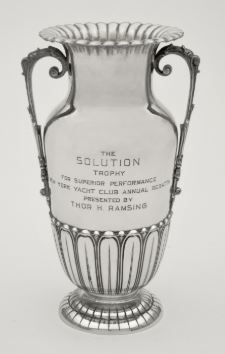
Solution Trophy
Buccellati, Milan
c. 1969
Trophy History: In 1969, Captain Thor H. Ramsing presented the Solution Trophy, which is named for two successive sailing yachts enrolled by him in the Club. The trophy was awarded for the first time in 1971.
Awarding of the Trophy: The Solution Trophy is to be awarded to the yacht enrolled in the Club which, in the opinion of the Race Committee, makes the best overall performance in the Annual Regatta. This Trophy need not be awarded if no yacht has a sufficiently outstanding performance.
Great Corinthian Trophy
Whiting Mfg. Co., New York
c. 1871
Trophy History: Presented in 1971 by the Seawanhaka Corinthian Yacht Club on the occasion of its Centennial Year, it commemorates a historic race of the same name conducted by Seawanhaka off Newport, Rhode Island, in September 1874, for schooners hailing primarily from Boston and New York. This race was significant in that it was the first to require that the helmsman be an amateur or Corinthian.
Awarding of the Trophy: The Trophy is awarded on a team basis to the club, other than the New York Yacht Club, represented in the Annual Regatta by three or more yachts that makes the best average point score, i.e., points accumulated by each Team will be divided by the number of yachts comprising the Team.
Rolex Cup
2004
Trophy History: This cut crystal bowl was presented by Rolex to the New York Yacht Club in 2004 in honor of the 150th NYYC Annual Regatta. The Board of Trustees dedicated the Rolex Cup as a perpetual trophy.
Awarding of the Trophy: The Rolex Cup is awarded to the best two-boat team in the NYYC Annual Regatta “Around the Island Race”.
6. Publicize Your Sustainability Efforts
Sailors received communications about what we were doing in several event-wide Bulletins leading up to the event. Here is an example of one: https://mailchi.mp/bedb2fa8d5ff/172th-annual-regatta-bulletin-9252149
7. Involve Local Organizations
A local composting company collects all of our compostable materials; any excess soil generated by our composting efforts go to local farms and gardens for their benefit. All regatta events had clearly delineated bins for compost, recycling, and garbage. The green team was instrumental in directing competitors to use the correct bins.
We also work with local fishermen and farmers to source fish and produce for our food and beverage offerings. For this event, this included regionally and locally sourced lobsters, and locally sourced produce, dairy, and breads. The Club works with Newport’s Tree Warden and the Newport Tree Conservancy to develop a succession plan for the trees on property and to replace trees that have been lost due to storms or age. The current replacement rate for lost trees is 2:1. The club also provides seeds and cuttings of rare, local plants and tree species to other organizations to help sustain the species.
8. Post Educational and Reusable Signage
Waste stream signage was reused from previous seasons and is durable/intended to be reused.
9. Serve Local Food or Source Seafood Sustainably
NYYC works with local fishermen, farmers, bakers and florists to
source fish, produce, breads, and flowers to complement what is
produced in-house for our food and beverage offerings. NYYC has an
herb garden, greenhouse and flower cutting garden on site to grow
many of the herbs for the dining room and cocktails as well as the
flowers for table-scapes. The locally sourced offerings for this regatta
included lobster, potatoes, herbs, produce for the salads, as well as
mint and other herbs for cocktails.
10. Organize a Green Team
Two sailors in the event were also Sailors for the Sea skippers and served as a Green Team leading up to and during the event. The Green Team met with regatta organizers before the event to discuss interventions to meet Platinum certification and were met with enthusiasm and support. The Green Team continued to coordinate with NYYC Sailing Office and Communications team members in preparation for the event.
11. Ensure Proper Waste Bin Placement and Signage
Clear signage demarked the different waste streams to help sailors, regatta officials and members quickly and accurately determine whether something should be composted, recycled or become garbage. They were available in the tent during the social events. Much of this signage is permanently in-place throughout the club house and grounds designating individual bins for compost, recycling, and garbage that cannot be diverted from traditional waste stream.
12. Divert Food Waste from the Landfill
Composting began at NYYC in 2018. We work with
a local vendor, Remix Organics to divert all food
scraps, paper goods, compostable flatware, coffee
cups, etc. to the compost waste stream. All pre
and post-consumer food waste included. For this
regatta, composting bins, complete with signage
and staffed by a member of the green team were
provided for the daily lawn parties held
immediately following the conclusion of racing.
13. Use Paperless Event Management
All communications were distributed through the regatta Whatsapp group or via VHF radio during the event. In advance of the event, the Bulletins were used and distributed via email. Yachtscoring continues to be the host site for viewing regatta documents and results to avoid the need for paper.
14. Host a Beach or Marina Cleanup
A beach clean up was challenging at this regatta for several reasons:
1. There is little beach area in the vicinity of the club: only a small strip of beach in front of Harbor Court that is already clean/maintained.
2. The event was decentralized in part due to size - and enabled by whatsapp communication - so competitors were docked or moored throughout Newport and Jamestown.
3. Competitors are coming from all over the country and staying throughout the surround areas (Newport, Middletown, Portsmouth, Jamestown) and there is virtually no time available to schedule a proper beach clean up offsite.
As an alternative, we instituted a "Leave No Trace" policy and encouraged sailors to pick up any physical pollution on land and onshore.
Language from regatta bulletin: "We encourage all competitors, support personnel, volunteers, and members to support the event’s sustainability initiatives by following a "Leave No Trace" approach both ashore and afloat. Take care not to leave trash behind. Take it a step further and pick up trash you might come across on the water or on land."
15. Prevent Toxins from Entering the Water
Fueling for all regatta-related equipment takes place off-site.
NYYC staff fuels and pumps out all boats for every regatta.
They employ industry best practices, thereby minimizing the
chance of spills and contamination. There are fuel spill
response kits readily available on the dock and on all boats
used for this regatta in case of any emergency. In addition to
the specific regatta fuel and biological waste, spill precautions,
NYYC has eliminated the use of chemical pesticides and
fertilizers on the lawn and gardens preventing toxic runoff
from reaching the water.
16. Increase Awareness of Wildlife and Habitat Protection
The New York Yacht Club is committed to the preservation of
local ecology and decreasing our carbon footprint. Rain
gardens provide a natural water runoff reduction system, slow
erosion and provide habitats for local flora and fauna. The
newly constructed docks and waterfront are designed to
account for rising sea levels, and more intense storms to
reduce damage, prevent pollution and safeguard facilities and
marine habitats.
For the Annual Regatta, the green team collaborated with regatta organizers to align on a protocol if wildlife was spotted on or near the racecourse, as this had been an occurrence in recent years. Participants were reminded that if wildlife is spotted on the racecourse, the Race Committee would alert participants and, if needed, provide directions for keeping the wildlife safe. Participants are also encouraged to communicate any wildlife
they spot.
Language from regatta bulletin:
"Be advised that certain marine mammals transit through Narragansett Bay and Rhode Island Sound this time of year. Please report any wildlife observed on or near the racecourse to the Race Committee, and take care to avoid disturbing wildlife whenever possible."
17. Offer Vegetarian or Vegan Alternatives
Vegetarian and vegan options were made available for
all regatta meals. This includes breakfast
offerings in the dining room and the grab and go café and the regatta dinner.
The regatta dinner offered a vegetarian salad and a vegan bean salad that provided a heartier protein option in addition to the salad. Other vegetarian offerings included vegetables and potatoes that were part of the family style meal alongside the fish and meat.
On an increasing basis, we are working with local
producers and purveyors to provide locally sourced
produce, meat, dairy, and seafood not only for
regattas, but throughout the year.
18. Promote Alternative Transportation
Sailors were encouraged in event communications to carpool to the venue to help with overflow parking and ultimately reduce the number of cars commuting to and from the regatta. Participants were actively encouraged to make use of the showers in the sailing center onsite to eliminate extra trips by car during the time in between sailing and the dinner. It's difficult to quantify the savings associated with this intervention, but the sailors who had the farthest commute home to shower would have been the most likely to make use of the showers onsite, eliminating extra trips to Middletown, Portsmouth, etc.
20. Inspire Future Action
The Green team was intentional about including language in all bulletins that went out to competitors that would encourage them to learn more and consider that they could host a clean regatta: "You can learn more about the Sailors for the Sea Clean Regattas certification here and consider whether your home club may be interested in hosting a Clean Regatta."
Ultimately the impetus for pursuing the Annual Regatta as a Clean Regatta stemmed from preparations for making the upcoming Women's Champs a Clean Regatta. The organizers were inspired and excited about the process and suggested that we pursue certification for all events at the club. We would not have pursued certification for the Annual Regatta if there had not been a certain degree of inspiration among non-Sailors for the Sea individuals.






Documents
- Annual-Regatta-Menu-2026.pdf – 17. Offer Vegetarian or Vegan Alternatives


